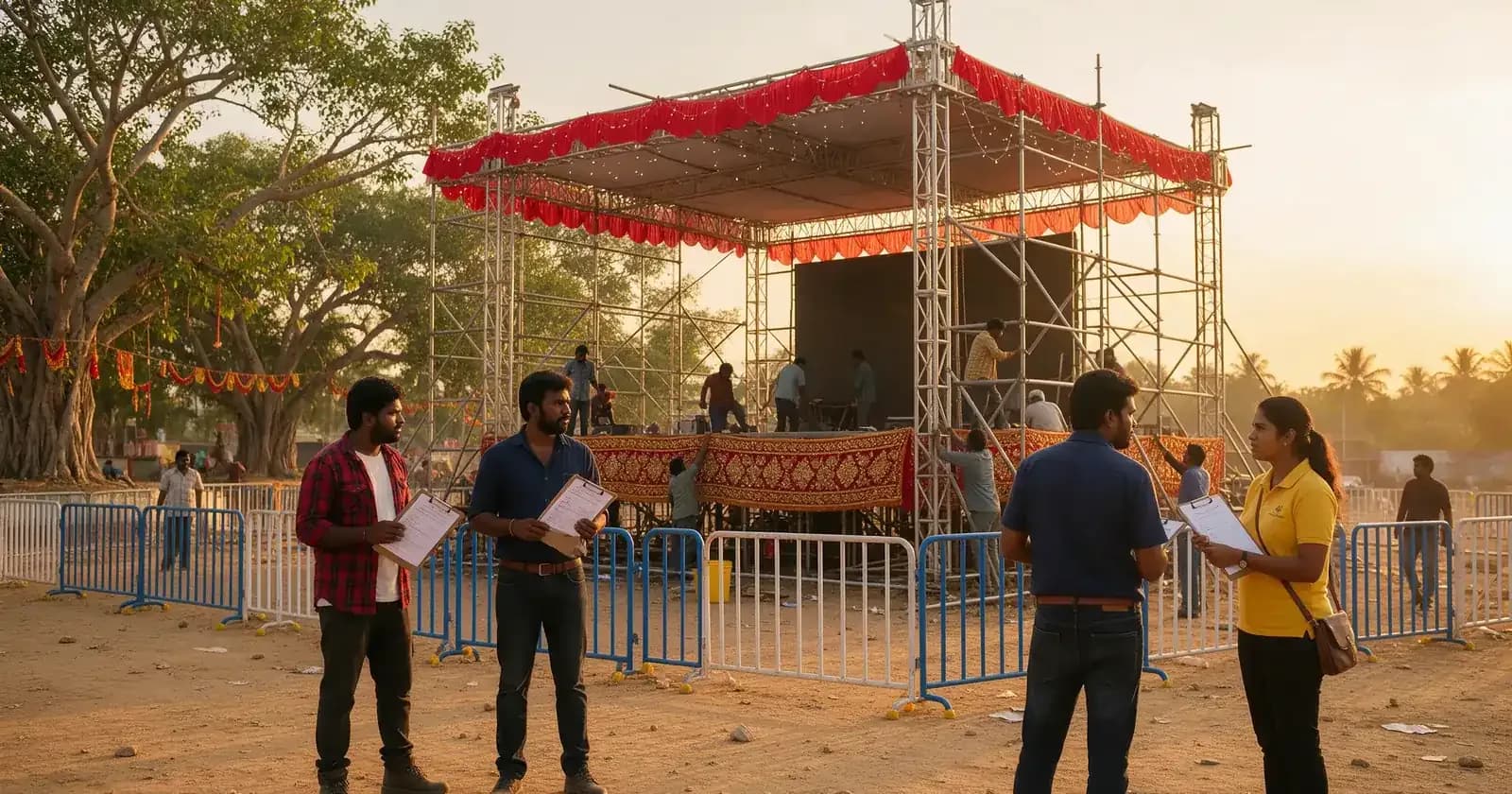
From police permission to local body and excise approvals — a planning timeline to work backwards from for an open-air event in Tamil Nadu or Karnataka. Confirm every step with the issuing authority.
Read this first: what this guide is and is not
This is a planning guide for an open-air festival, concert or large outdoor show in Tamil Nadu or Karnataka. It describes the general shape of the approvals, the order they usually depend on each other, and a timeline you can work backwards from. It is not legal advice, and it does not quote fees, section numbers or statutory deadlines.
Rules, forms, fee schedules and even the name of the issuing office change by city, by venue, by season and by year. Bengaluru's civic administration, for example, has been going through a restructuring, so the body that used to be called BBMP may now be handled by a different authority or zone office. Anywhere this article says confirm, it means: ask the issuing authority in writing, or ask a local lawyer or licensed event-permit consultant, before you commit money.
The most useful thing we can give you is the sequence and the failure modes, because that is where shows actually get hurt.
The approvals map: who you will deal with
For almost any outdoor ticketed event with sound, a crowd and a temporary structure, you should expect to deal with some or all of the following. Which ones apply depends on your venue, your capacity and whether you serve alcohol.
•Police permission for the event. In a metro this usually goes through the Commissioner of Police's office or the jurisdictional police station or division. This is the approval most other offices will ask to see, or will be asked about by the police.
•Fire safety clearance. The state fire and rescue service (in Tamil Nadu, the Tamil Nadu Fire and Rescue Services; in Karnataka, the Karnataka State Fire and Emergency Services) inspects temporary structures, stage, exits and extinguishing arrangements. A permanent venue may already hold a fire certificate, but a temporary layout inside it often needs its own look. Confirm.
•Local body permission. The city corporation or municipal authority or the panchayat, for use of a public or semi-public ground, signage, hoardings and sometimes waste handling. In Bengaluru this has traditionally meant BBMP; confirm the current body and zone office.
•Structural and electrical safety. A structural stability certificate from a qualified engineer for the stage, truss and towers, and an electrical safety sign-off for temporary power, including generators. The state electrical inspectorate or the power utility may be involved. Confirm who signs what.
•Music licences. Permission from the bodies that represent the rights in recorded music and in compositions (PPL and IPRS are the two most commonly named; more below).
•Excise or liquor permission if alcohol is served or sold.
•Medical and ambulance arrangements, which the police and fire offices will usually want to see written into your plan.
•Venue or landowner consent, in writing, including who is liable for damage.
•Noise and pollution rules, including generator noise and the hours your sound is allowed to run.
Treat this as a checklist of conversations to start, not a promise that each one is a separate office. In some cities a single-window or online portal collects several of them; in others you walk a file between desks.
The dependency chain that causes most delays
Most permit delays are not caused by slow offices. They are caused by a circular dependency the organizer did not see coming.
A typical loop looks like this:
1.The police ask for a fire clearance and a structural certificate before they will issue permission.
2.The fire office asks for the final site layout and the police permission reference.
3.The structural engineer cannot certify until the stage vendor freezes the design.
4.The stage vendor will not freeze until the artist's production rider is final.
You break the loop by freezing things in the right order: venue, then capacity and layout, then production design, then certificates, then applications. A layout that changes after the fire inspection can mean starting that approval again.
Two practical rules follow from this:
•Fix your licensed capacity early and design everything to it. Capacity drives exits, toilets, medical cover, barricading and fees. If you later want to increase capacity, treat it as a new application, not an edit.
•Keep one compliance file with the same final layout PDF, the same capacity number and the same dates in every application. Offices compare documents. Inconsistencies create queries, and each query costs days.
A working timeline, counted backwards from show day
These lead times are planning assumptions, not guarantees. Large cities, big crowds, alcohol and public grounds all lengthen them. Ask each office for its real turnaround and build a buffer on top.
T-90 to T-60 days: foundations
•Lock the venue and get the owner's written consent.
•Fix capacity, layout draft, stage position, entry and exit flow, parking and drop-off.
•Appoint a licensed event-permit consultant if you do not have in-house experience in that city.
•Start the music licence enquiries. They are usually the least dependent on anyone else, and the cheapest to start early.
T-60 to T-45 days: documents
•Final layout drawings, with exits, fire points, first-aid posts and barricading marked.
•Structural design and engineer's certificate plan; electrical plan including generator capacity.
•Crowd management plan, security headcount and ambulance arrangement.
•Draft evacuation plan: how many minutes to empty each zone, who announces, who opens which gate.
T-45 to T-30 days: applications
•File the police application with the full document set. In Chennai and Bengaluru, expect queries and at least one clarification round.
•File for fire clearance as soon as the layout is final and before it is changed.
•File the local body application in parallel.
•If serving alcohol, start the excise process now and not later. This is often the slowest and most heavily scrutinised track, and the rules differ sharply between the two states. In Tamil Nadu, liquor retail is run through a state system and event-level service is understood to be tightly restricted, so ask the excise office early whether it is possible for your event type at all. Confirm.
T-30 to T-14 days: queries, inspections and corrections
•Expect inspections of the site, and requests to amend the evacuation or medical plan.
•Answer queries within a day or two. A query that sits for a week eats your buffer.
•Do not change the layout without telling every office that already holds a copy.
T-14 to T-7 days: licences in hand
•Collect the written permissions and keep originals and scans on site.
•Brief your own team, security vendor and stage vendor on conditions attached to the permissions: closing times, sound limits, capacity, no-go zones.
T-7 to T-0: final checks
•Re-confirm any conditional approvals, final headcount and the on-site inspection if one is due.
•Print the permissions and keep them at the production desk and at each gate manager's briefing.
Why marketing and ticket sales should wait for the right paper
A common question from promoters is when it is safe to announce and start selling. There is no universal answer, and a lawyer should advise on your case, but there is a clear risk logic.
If you sell tickets before the police permission exists and the permission is refused, delayed or issued with a lower capacity, you may face a refund exercise, a reputational hit and possibly consumer complaints. The conservative rule many experienced organizers follow: announce the artist and the city early, but do not publish a specific venue and open general sales until the main permission is in hand or you are very confident of it. If you must sell earlier, write a clear refund policy for a permission-related cancellation and state it on the event page before the first sale.
Whatever you decide, make the capacity you sell match the capacity on the permission. Selling above the licensed number is the quickest way to turn a good show into an enforcement problem.
Music licences: PPL, IPRS and what they cover
Playing music at a ticketed event involves more than one right. In India, two organisations are most commonly named.
•PPL (Phonographic Performance Limited) licenses the public performance of sound recordings, for example a DJ playing released tracks or a playlist between acts.
•IPRS (Indian Performing Right Society) represents authors, composers and publishers, and licenses the public performance of the underlying musical and literary works. It is relevant when songs are performed live as well as when recordings are played.
These are different rights, so the same song can need permission under both. Other bodies and direct arrangements with a rights holder or a record label may also apply in specific cases, for example for particular languages or catalogues. Confirm which ones your programme touches.
How to handle this without getting trapped:
1.Build a set list or music policy early: live original music only, live covers, DJ sets, background playlists, film songs, regional catalogues.
2.Ask each society how it calculates the licence for your event. Methods usually involve event type, duration and capacity or ticket value, but the formulas and amounts are theirs to state. Do not budget from a number you found in a blog post, including this one.
3.Apply early, ahead of the other approvals. Some police offices ask for proof of music licences, and some artists' contracts make the promoter responsible for them.
4.Keep the licence copies with the permissions file and give a copy to your stage manager.
5.For headliner contracts, ask who holds which rights. If an artist performs only original songs they control, the position can be different. Get this in writing from the artist's team.
Unlicensed public performance is a real exposure: rights holders can seek injunctions or damages, and a notice on show day is the worst possible timing. Do not leave this to the last week.
Common mistakes, and how to avoid them
•Starting with the application, not the layout. Changing layouts after inspection resets clocks. Freeze first.
•Assuming the venue's old certificate covers your event. A venue's fire or occupancy certificate may not cover a temporary stage, a tent or a larger crowd. Ask.
•One person holding the whole file. Keep a shared folder, a log of every application with date, reference number, officer name and status, and a named backup.
•Under-budgeting time for corrections. Budget two query rounds per approval as a base case.
•Ignoring conditions. Permissions often carry conditions on hours, sound levels, capacity and crowd control. Brief the full crew. A breach on show night can lead to the show being stopped.
•Letting vendors apply on your behalf without sight of the paper. You can use a consultant, but get copies of everything and make sure the licence is in the name that matters for your event.
•Treating a rumour as a rule. "Everyone gets it in a week" is the sentence before a missed deadline. Ask the office.
•Not planning for refusal. Decide in advance what you will do if the permission arrives with reduced capacity or a changed closing time: price changes, ticket caps, and refund triggers.
Wrap-up: a checklist for this week
If you are planning an outdoor event in Tamil Nadu or Karnataka, do these before anything else:
•Confirm the venue in writing, including the owner's consent and who holds existing certificates.
•Fix capacity and a draft layout, and write down the licensed number.
•Make a one-page list of every approval you think you need, with the issuing office, the contact, the document set and the expected turnaround, each marked confirm until the office says otherwise.
•Start the music licence enquiries with PPL and IPRS, with your music policy ready.
•Decide whether alcohol is in scope, and if so start the excise conversation first.
•Book a structural engineer and an electrical contractor who can sign off.
•Draft the evacuation, medical and crowd management plans.
•Build the timeline backwards from show day with a buffer for two query rounds.
•Write your refund policy for permission-related changes before the first ticket is sold.
•Keep one compliance folder, shared with your team and your ticketing partner.
When your approvals are in place, ticketprix lets you publish the event, set ticket types and quantities, and cap what you sell at the number your permission allows. The permits themselves remain between you and the issuing authorities, so confirm each one directly.