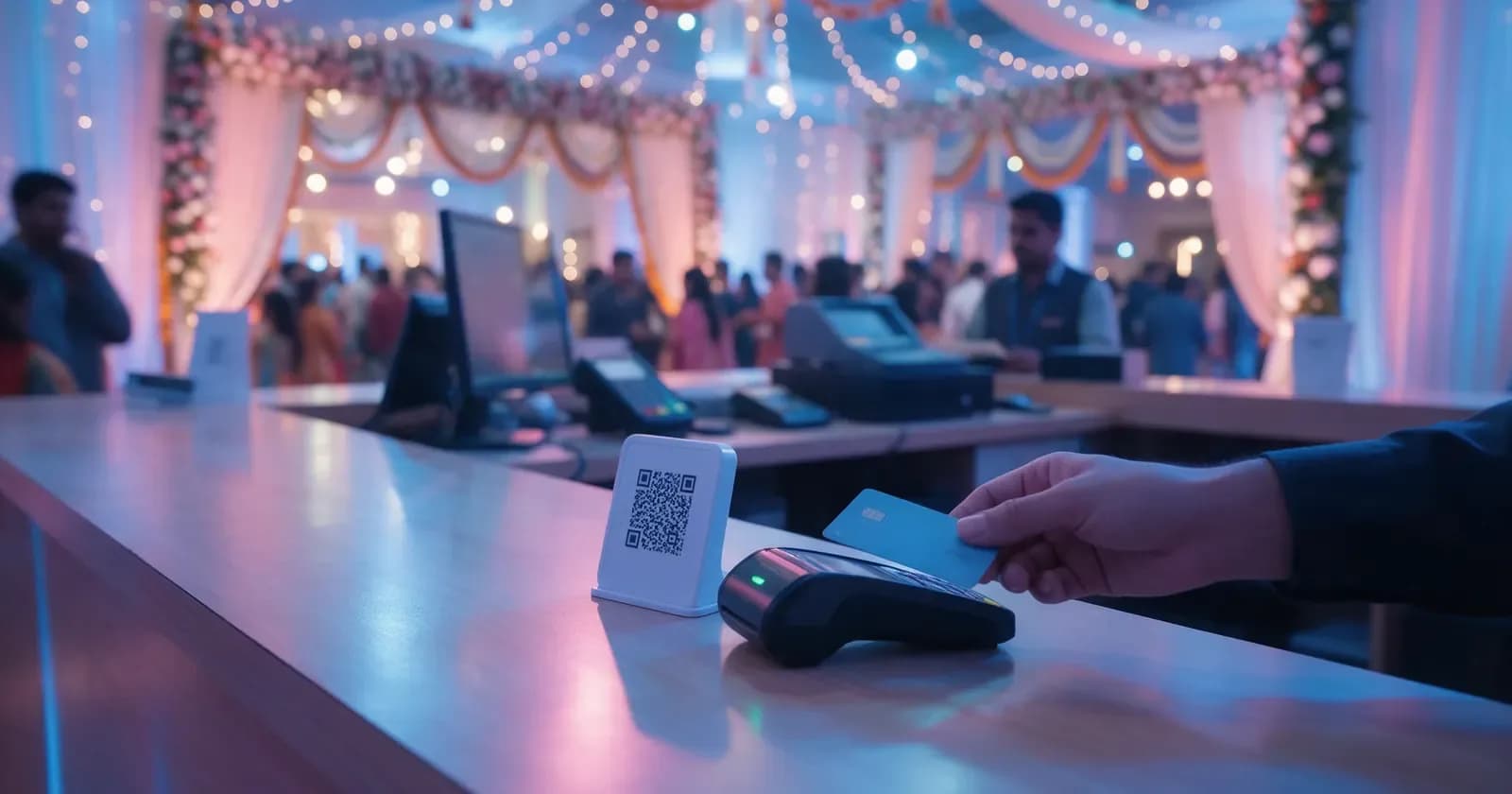
A vendor-neutral guide to festival wristbands: hardware, top-up models, refund flow and the customer-care script you will need on Day 2 of a Goa or Pune festival.
What this guide is, and what it is not
Cashless wristbands are now common at multi-day music festivals in India, from the beach festivals of Goa to the weekend festivals in Pune, Bengaluru and Delhi-NCR. Sunburn, NH7 Weekender and VH1 Supersonic are the names most readers know, and festival-goers there have seen wristband-based entry and payments in different forms.
This is a planning guide drawn from how cashless systems generally work, not an account of what any of those festivals do internally. We do not know the vendors, volumes or numbers behind those events and we are not claiming to. Where we give figures they are illustrative arithmetic, or rules of thumb for you to test. Also be clear on one point: ticketprix is a ticketing platform. We do not sell or operate RFID wristbands or a festival cashless wallet, so this guide is vendor-neutral and about the decisions you face when you buy that service from a specialist.
The main message is simple. A wristband programme succeeds or fails on operations, not on the chip. Entry, top-ups, payments and refunds all have to work for tens of thousands of people over several days, with weak networks and tired, hot, hurried guests.
Choose the job the wristband must do
Start with scope. A wristband can do any combination of these jobs, and each added job adds risk.
•Entry only. The band replaces a paper ticket or QR scan at the gate. Simplest, and often the first step.
•Access control. Different zones such as VIP, backstage, camping or artist areas.
•Cashless payments. A stored balance spent at food, drink and merchandise stalls.
•Extras. Lockers, charging stations, photo sharing, age verification for bars.
If this is your first season with wristbands, consider entry plus zone access first, and add payments only when you have the staff and process to support them. Payments are where complaints, refunds and regulation arrive together.
Know the hardware vocabulary
You do not need to be an engineer, but you should be able to ask sensible questions.
•RFID and NFC. Most festival wristbands use short-range 13.56 MHz chips that the guest taps on a reader. Many phones can read NFC, but festival systems normally use dedicated readers.
•Chip family. Some cheaper chip families have well-known security weaknesses, which is why the band should hold only a random identifier while the money and the permissions sit on the server. Ask the vendor how they prevent cloning.
•Read distance and speed. A tap should register in well under a second. Test with a wet wrist, a thick band over a sweaty arm and a phone in the other hand.
•Durability. Bands should survive rain, sand, showers and several days, and should be tamper-evident so one cannot be moved to a friend.
•Readers. Handheld readers suit gates and roaming staff. Fixed readers or tablets suit bars and food stalls. Check battery life against your longest shift.
Ask each vendor for references you can call, details of what happened when a site lost internet, and how many transactions their system has processed at a single event. Treat anything they say about their own performance as a claim to verify, not a fact.
Plan for the network failing
Every outdoor festival tests connectivity. A cashless system that cannot work offline is a risk to your revenue and your reputation.
•Ask whether readers can approve small payments offline and sync later, and what limit applies. A common approach is to allow offline purchases up to a small amount and require connection above it.
•Use dedicated connectivity for the readers rather than relying on guests' phones or venue Wi-Fi, which can saturate when thousands of people are online.
•Keep a local server or gateway on site if the vendor offers one, so that a cloud outage does not stop the festival.
•Have a written failure procedure: what stalls do if readers go down for ten minutes, who authorises cash sales, and how sales are reconciled later.
Practise the failure in a rehearsal. Unplug the network during testing and see what the crew actually does.
Design the top-up experience
Your top-up model decides how long people queue before they can spend a single rupee.
Typical options are:
1.Online or app top-up before and during the festival. Fast and easy to track. Works only if guests have signal and have registered their band.
2.Top-up kiosks or counters accepting UPI. A QR code on a screen lets guests pay from their own phone. Counters need enough staff, and UPI success depends on the network.
3.Cash at a counter. Needed for inclusiveness, but it is the slowest and creates queues and cash-handling risk.
Do the arithmetic before you choose. Say a festival expects 20,000 guests on a day, and half of them top up during the festival at counters. That is 10,000 transactions. If a counter staff member can complete a top-up in 45 seconds, one counter handles 80 an hour. To clear 10,000 top-ups across, say, a five-hour window, you need 10,000 divided by 5, which is 2,000 an hour, and 2,000 divided by 80 is 25 counters. Online pre-loading that moves even a third of those people away from the counters reduces the number sharply.
Rules of thumb to test with your own audience, not facts about any particular crowd:
•Encourage pre-loading with a small incentive such as a welcome drink, since every pre-loaded rupee is one fewer queue.
•Keep counters away from entry gates and main walkways.
•Put top-up points near stall clusters so guests can refill when they run low, not only at the entrance.
•Show minimum and maximum top-up amounts clearly so people do not top up ten times in small amounts.
Decide refunds and commercial terms before the festival
Refunds of unspent balance are the most common source of friction, and the part with the highest legal sensitivity.
Choose one policy and publish it in the ticket terms, the app and on signs at top-up points:
•Automatic refund to the original payment method within a stated number of days.
•Refund on request through a form with a deadline.
•Balance rolls forward to the next edition (this needs careful consent and legal advice, and in many cases a refund option is expected).
•Minimum amounts and any fees, if you charge them. State them plainly.
Rules around stored-value instruments and refunds can be nuanced. Talk to a lawyer or a payments specialist about how Indian payment regulations apply to the way your vendor holds and returns guests' money, and which party is the regulated entity. Do not assume the vendor's standard terms are enough for your event. Confirm anything about refund timelines with them in writing.
Also settle who bears the cost of failed or duplicate transactions, and how you reconcile stall sales against the wallet ledger. Your finance team should receive a clean reconciliation by stall and by day.
Budget and commercial terms to negotiate
Cashless programmes are priced in several different ways, and the headline figure rarely tells the full story. Ask each vendor to quote the same scenario so you can compare.
•Per-band cost. Includes the chip, the strap and printing. Ask what happens with unissued bands and whether returns are accepted.
•Hardware rental versus purchase. Readers, kiosks and a gateway server are often rented per event.
•Transaction fee. Some vendors take a percentage of every cashless sale, others charge a flat fee. Work out what that does to your stall partners' margins before you agree it.
•Support staffing. Is on-site support included, and for which hours?
•Unspent balance. Agree in writing who holds money between top-up and refund, and how any unclaimed amount is treated, subject to the legal advice mentioned above.
A simple check: take your expected number of guests, an assumed average spend, and the vendor's fee, and compute the total cost as a share of cashless sales. Run it at 50 percent and at 150 percent of your forecast. If the answer still works at the lower figure, the deal is safer.
Day 2 is where programmes get tested
Day 1 is excitement. Day 2 is when problems accumulate: balances run low, tired guests misread screens, a reader fails mid-transaction and a guest wonders whether they were charged twice. Plan for this day deliberately.
•Make the balance easy to check. A guest should be able to see their balance on a reader at any stall, on a screen at a help desk, or via a link or app.
•Give the help desk a transaction history. The best de-escalation tool is a clear list of what was charged, when and where. Offer to show it before the guest gets angry.
•Pre-write the script. For example: "I can see your balance on the reader right now. Let me show you the last few transactions and we can check them together. If anything looks wrong I will raise it here and you will get a reference number." Train staff to acknowledge, show data, offer an action and give a reference, in that order.
•Escalation path. Define what the front-line person can fix alone (a clear duplicate charge under a set amount, for instance) and what goes to a supervisor.
•Language. Staff in Goa, Pune or Delhi should be able to help in English, Hindi and the relevant regional language. Provide printed phrases for the common situations.
Track the volume of balance and refund queries by hour. We do not publish a benchmark percentage here because it depends heavily on the event, the vendor and the audience; measure yours on Day 1 and staff Day 2 accordingly.
Things that go wrong, and how to prevent them
•Bands registered to the wrong ticket. Link each band to a ticket at the point of issue, and scan the ticket, not the person, when swapping.
•Lost or damaged bands. Define a replacement process that transfers the balance after identity checks, and block the old band immediately.
•Under-18 and alcohol rules. If age checks are tied to the band, decide how the rule is encoded and who verifies it. Rules on alcohol service and age limits differ across states, so confirm with local authorities and your licensed bar operators.
•Stall staff not trained. Run a briefing and a practice session for every stall owner and their cashiers.
•Data protection. Collect only what you need, tell guests how it will be used, and agree with the vendor how long it will be kept and who can access it.
Wrap-up: your wristband readiness checklist
Use this list in the months before your next festival.
•Decide the scope: entry only, zones, or full cashless payments.
•Shortlist vendors and call their references, including one about a network failure.
•Run a rehearsal with the network cut off.
•Do the top-up arithmetic for your expected crowd and size the counters.
•Set the refund policy and publish it everywhere guests will look, after taking legal and payments advice.
•Build a help desk with a transaction history view and a pre-written script.
•Train every stall and counter staff member, in the languages your guests use.
•Prepare a lost-band and replacement process.
•Agree reconciliation reports for finance by stall and by day.
•Review the Day 1 query volume and adjust Day 2 staffing.