Why cost per purchase climbs a few days into a Meta campaign, a six-creative weekly rotation rule to test, and creative tests for Tamil, Kannada and Malayalam audiences.
The pattern: a good first three days, then a cliff
If you have run Meta (Facebook and Instagram) ads for a concert, comedy show or festival in South India, you may have seen this shape. Days 1 to 3 look healthy: cost per purchase is low, return on ad spend (ROAS) is above target, and the team relaxes. Then somewhere around Day 4, cost per purchase climbs and ROAS drops, sometimes sharply, without anyone touching the campaign.
We call this the Day 4 cliff. Treat the exact day as a rule of thumb to test, not a law. On a small budget it may arrive on Day 6; on an aggressive budget it can arrive on Day 2. What stays constant is the cause: the best-fit people in your audience have already seen your ad, and the system is now spending to reach everyone else.
This article explains the mechanics, gives you a rotation rule you can run from a spreadsheet, and then covers how to adapt creative for Tamil, Kannada and Malayalam audiences in Chennai, Bengaluru and Kochi. The regional notes are hypotheses to test with your own data, not facts about any community.
Why ROAS falls: three separate causes
Teams usually blame "the algorithm" for the drop. In practice at least three different things are happening, and they need different fixes.
•Creative fatigue. The same image or video is shown to the same people repeatedly. Click-through rate falls, and when it falls, Meta's auction charges you more for each impression.
•Audience saturation. An event has a small pool of people who are likely to buy: fans of the artist, people who attended the last edition, people near the venue. A small pool is exhausted in days, not weeks. After that you are paying to persuade people who were never going to buy.
•Learning and budget effects. A new ad set needs roughly 50 optimisation events (for example purchases) in about a week to leave Meta's "learning" phase, a figure Meta itself documents. Early on, the system exploits whatever worked first. Later it explores wider, and that exploring costs money.
Why does an event suffer more than an e-commerce brand? Because an event has a hard end date and one product. A clothing brand can run the same ad for months to a huge audience. You have a finite pool and a fixed countdown.
Read the symptoms before you change anything
Open Ads Manager and add these columns: frequency, unique link click-through rate (CTR), CPM, cost per landing page view, and cost per purchase. Then compare Day 1 to 3 against Day 4 onward.
•Frequency rising past roughly 3 to 4 in a week while CTR falls: this points to creative fatigue. Fix with new creative.
•CPM rising while CTR holds steady: the audience is saturating or competition (a rival event, a festival weekend) is pushing auction prices up. Fix with new audiences or timing, not new creative.
•CTR fine, landing page views fine, purchases falling: the problem is after the click. Check price, sold-out tiers, page speed and payment errors before you blame the ad.
Frequency thresholds are a starting guess. Some events tolerate higher frequency because the offer is strong and the audience is warm. Use your own history to set the line.
The six-creative weekly rotation
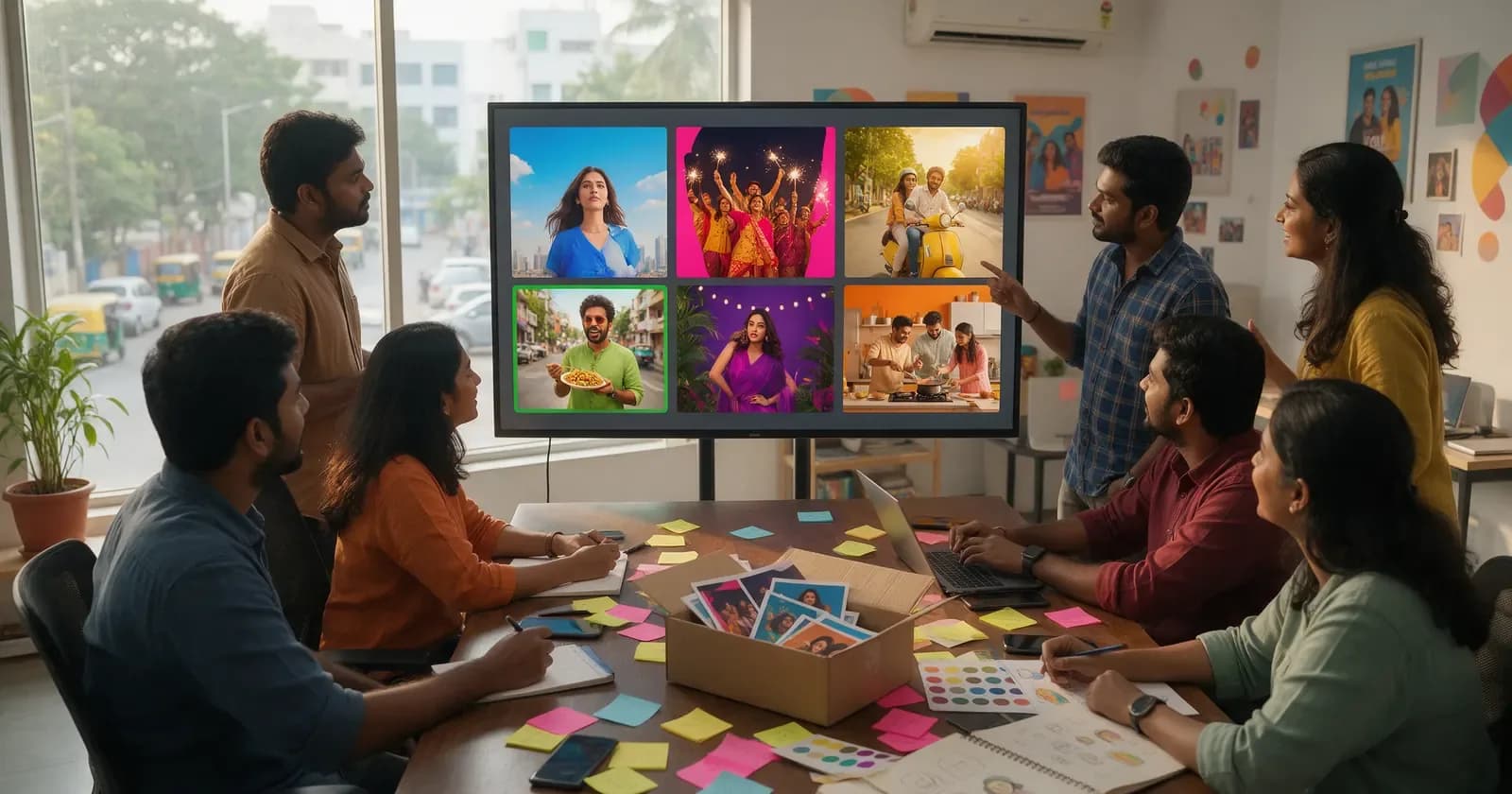
The rule we suggest is simple: never run fewer than six distinct creatives in a week, and group them by job, not by look.
•Creatives 1 and 2: announce. Who, where, when. Hero image or a short video with the lineup.
•Creatives 3 and 4: reassure. Answer the objections a buyer has: how to reach the venue, what the seating looks like, what is included in the ticket, the refund or transfer policy. Real photos from a previous edition work better than stock art. Only use social proof you can back up, such as an actual count of tickets sold, never an invented one.
•Creatives 5 and 6: close. Give a real reason to act now: an early-bird deadline, a price step, a tier that is genuinely running low.
Rotate on a schedule, not on a feeling. A workable cadence:
1.Day 1 to 3: run the announce pair plus one reassure creative.
2.Day 4: bring in the remaining reassure creative and pause the weakest announce creative.
3.Day 5 to 7: add the close pair as soon as a real deadline or inventory signal exists.
4.Every week: retire the bottom two creatives by cost per purchase and replace them with new variants.
This is different from flighting, where you run one message for a block of days and then switch wholesale. Flighting makes the whole audience see the same thing and then see a new thing. Rotation keeps several messages live so each person sees a varied sequence. Rotation is a reasonable default because it spreads exposure, but it is a hypothesis: test it against your own flighted campaigns before you trust it.
A worked example with the arithmetic
These numbers are illustrative, not ticketprix results. Say you have a 3,000-seat show in Bengaluru with an average ticket of ₹1,500 and a Meta budget of ₹60,000 over the first week.
•Your break-even ROAS on ad spend alone is 1.0 (every ₹1 in ads returns ₹1 in ticket revenue). You will want a higher target to cover artist costs, so say you target 4.0.
•Days 1 to 3 spend ₹24,000 (₹8,000 a day) and return ₹1,10,000 in ticket revenue. ROAS is 110,000 / 24,000, about 4.6.
•Days 4 to 7 spend ₹36,000 and return ₹90,000. ROAS is 90,000 / 36,000 = 2.5.
Blended week ROAS is 200,000 / 60,000, about 3.3, which hides the problem. Your Day 4 to 7 ROAS of 2.5 is below target. If you had held spend back and refreshed creative at Day 4, even a partial recovery to 3.5 on that ₹36,000 would produce ₹1,26,000 rather than ₹90,000, a ₹36,000 difference. Always split ROAS by period; the blended number delays your reaction by days.
Language and city: hypotheses to test
Chennai, Bengaluru and Kochi are different markets, and the languages on a buyer's phone are a creative variable. None of what follows is a fixed rule; each line is a hypothesis to run as a split test.
•Tamil (Chennai, Coimbatore): test the artist or film name in Tamil script in the first frame against the same name in English. Test voiceover or captions in Tamil for video.
•Kannada (Bengaluru): Bengaluru is also strongly multilingual, with large English and Hindi speaking audiences. Test Kannada, English and mixed copy separately. Logistics (traffic, parking, Metro access, last train time) is a plausible lead for city venues, so test a logistics-first creative against an artist-first one.
•Malayalam (Kochi, Thiruvananthapuram): test an experience-led creative (the atmosphere, the crowd, the night out) against an artist-led one.
For each test, change one thing, give each variant the same budget and compare cost per purchase, not CTR. A creative that attracts clicks from browsers who never buy is a loser, however good its CTR looks.
Also have a native speaker review every line. Machine-translated Tamil, Kannada or Malayalam is easy to spot and can damage trust. The script, the register (formal or casual) and the transliteration of artist names all matter.
Common mistakes
•Editing live ads. Changing a running ad can reset its learning. Duplicate and replace instead.
•Judging a creative on 24 hours of data. Wait until each creative has had a meaningful spend, for example several times your target cost per purchase, before pausing it.
•Ignoring existing buyers. Exclude people who already bought, using your customer list or the purchase event, so you do not pay to advertise to them.
•Only prospecting. Keep a separate small budget for people who viewed the event page but did not buy. Their message should answer the objection (price, travel, refund policy), not repeat the announcement.
•Faking urgency. Do not claim "last tickets" when they are not. Ad platforms and buyers both punish it.
•Counting platform ROAS as truth. Meta attributes purchases it can see. Compare against ticket sales by source from your own reports before you shift budget.
Wrap-up: what to do this week
If you manage an event on ticketprix, the ticket sales in your reports give you an independent check on what Meta reports. The rotation rule works with any ticketing platform.
1.Pull your last campaign and split ROAS into Days 1 to 3 and Day 4 onward. Find your own cliff day.
2.Write six creatives grouped by job: two announce, two reassure, two close.
3.Set a rotation calendar and a retire-the-bottom-two rule before launch.
4.Add frequency, CPM and cost per purchase columns to your daily check.
5.Pick one language or city hypothesis and run it as a clean split test.
6.Exclude past buyers and set up a small retargeting ad set.
7.Compare Meta's numbers with your actual ticket sales every Friday.